

The internet with all its information available can be a blessing, but without structure it will just be a mass of advice. Most of these tips are correct, just not necessarily for your level! The tricky thing is that despite some of them being true for someone advanced, it might not be a good thing to follow for lower-rated players.
An example: “Don’t castle too early, so your opponent will not know where you will put your King”. True? Absolutely. What will happen if a beginner player follows this advice? In my experience, disaster. Or another one: “Exchange pieces if you don’t have enough space”. Again true, but if you’re less experienced, first you should probably notice that your Queen is hanging.
An issue with so much information is that there are a lot of things to pay attention to and think about in chess, and if you try to do all of them at once, you’ll just get overwhelmed. That’s why I believe that if you are below a certain rating, you shouldn’t consume a lot of content intended for higher-level audiences.
This article is mostly aimed at players roughly below 1200 rapid Chess.com rating / 1500 rapid Lichess rating, and anyone who has accumulated lots of advice but whose board vision and basic threat-awareness haven't caught up with that knowledge yet.
So what should you focus on instead?
I think it’s much more useful to concentrate on a few things really, really well than to worry about every advanced concept you come across. Your games will not be decided by a good Knight outplaying a bad Bishop, nor by suffocating your opponent when they play too passively. They’ll be decided because someone forgot a piece was hanging, or that a vulnerable piece required more care.
Once you get past this level, you can gradually start adding more advanced concepts to your thinking process. However, until that, let’s pretend that material is “everything.” Of course it isn’t. You can see strong players sacrifice material for activity and for other alien positional nonsense, but the difference is that they know why that is fine (or not, and mess up as well :)).
I have seen surprisingly many players tell me they gave a pawn, because “it’s just a pawn” and they “didn’t want to pause their plan to defend it”. Or sacrificing for a “better attack” or a “better center”. No. With extra material one’s life is so much easier, so first you need to learn how to get free pawns and pieces, and just as importantly, how not to lose your own.
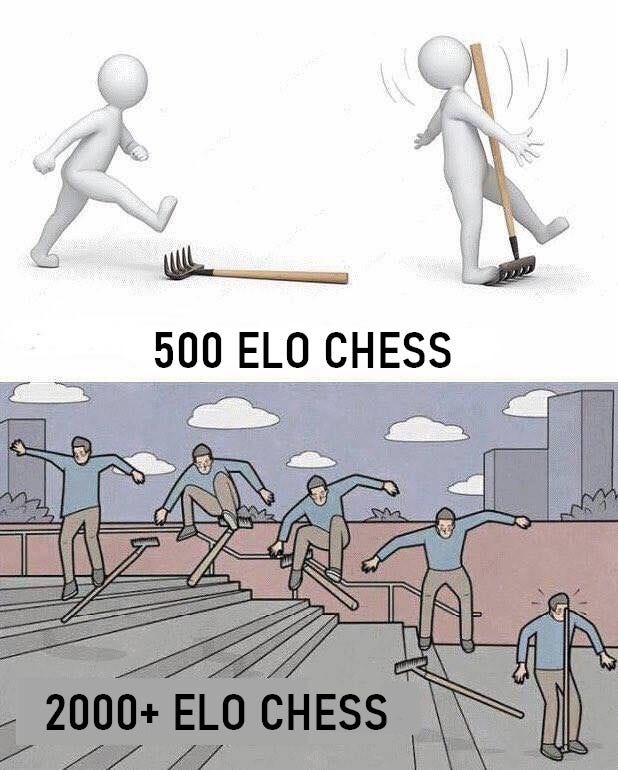
What are the vulnerable pieces?
Vulnerability is a bit complicated, because what will be vulnerable for a lower-rated person is not necessarily weak for a master, and vice versa, but we still need to identify them to the best of our ability.
Before we begin with the thinking method, we need to discuss what makes a piece vulnerable. I like to use markers during a game:
I mark a piece with red, when it has either more attackers than defenders or it’s attacked by a less valuable piece. These are the first things you need to look at, as they can lead to winning or losing material if you are not careful.
There are also yellow pieces, meaning they have the same number of attackers as defenders. This doesn’t necessarily mean they are certainly secure at the moment. They appear safe (no checkmate or material loss) and solid, but they can become a problem any time, maybe even in this exact moment! Even if not, keep an eye on them until they are vulnerable.
Lastly, a piece is green, if it’s completely safe: it has more defenders than attackers, and it isn’t attacked by a less valuable piece. These don’t require immediate attention, and you don’t need to spend too much mental energy on them, nor do you need to actively search for them and identify them all.
These are guidelines rather than pure definitions; it’s all about whether you can lose or win material. You still need to consider if the pieces can really capture each other.
Vulnerability is dynamic though, these colors aren’t permanent, they change as the position changes. The board doesn't stay the same, so your priorities shouldn't either. The colors are there to help you reassess after every move, not to provide a fixed plan for the entire game. To avoid misunderstandings, these also don’t mean “good” or “bad”, instead they are information. They represent attention priority, letting you know what you should likely take/attack or defend/move away or keep in mind.
Let’s see these positions. To not make you more confused, I didn’t highlight everything with colors, only a few examples.
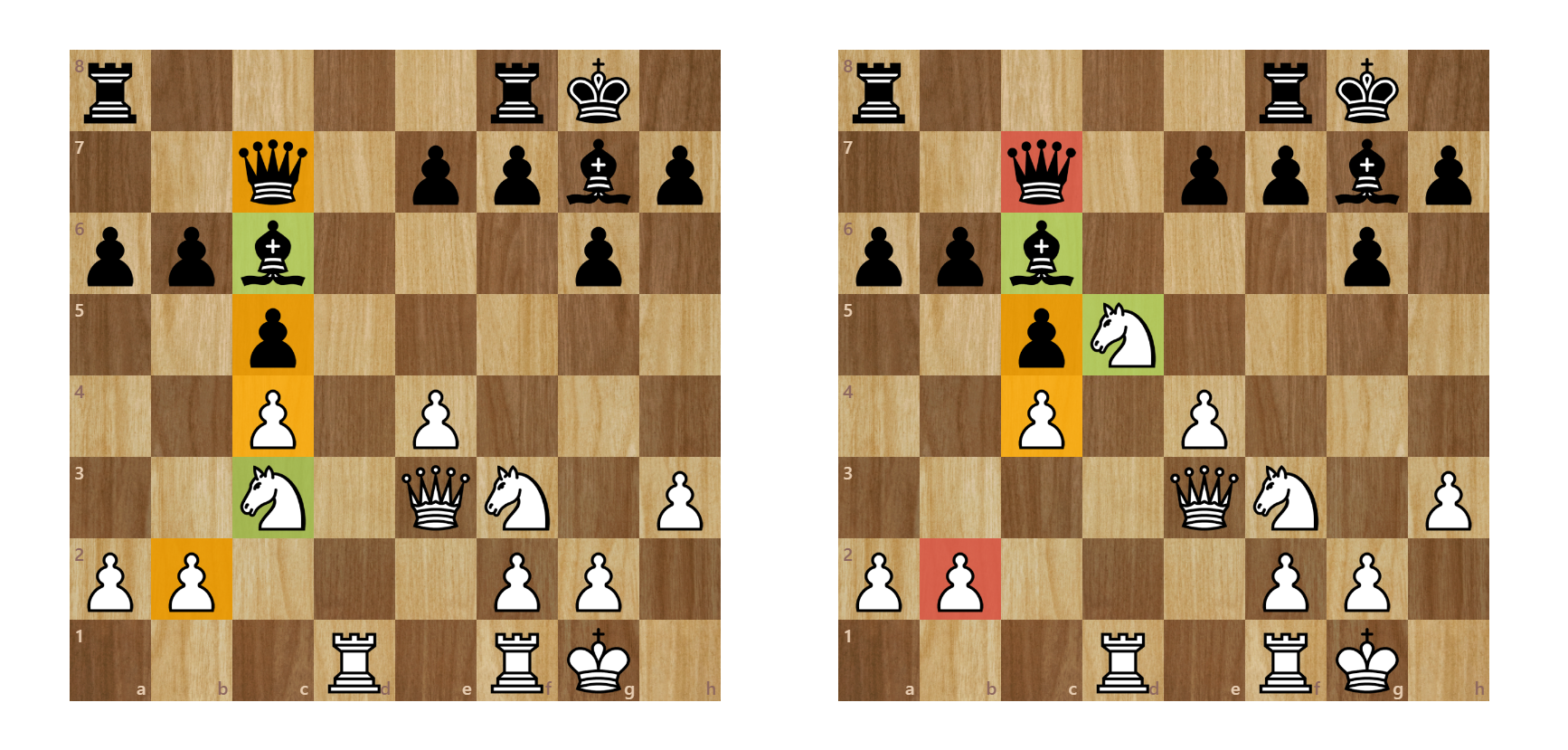
In the first position, White’s b2 and c4 pawns are yellow, because even though they aren’t attacked by anything at the moment, they aren’t defended either. Black’s c5 pawn is vulnerable (yellow), because despite being defended by b6, it’s also attacked by the e3 Lady. I colored the Queen yellow, because high-value pieces always deserve a little extra attention (if something attacks them, their number of defenders won’t matter).
They’re fine for now, but they’re worth remembering. Why? Imagine you play this position as Black, and say, yeah, c5 is no problem at all. In your mind it will go into an “all good” box, and you will likely never look at it again. A few moves later, you want push the b-pawn to b5, and check out if the move is safe. Great, the pawn on b5 is ok, so you play it. Then at your worst surprise, White takes the c5 pawn for free, and you just can’t understand how you missed that. You did, because you didn’t think it was important to remember your possible problem pieces. :)
Back to the examples. The c3 Knight is green, because it’s defended by two (b2 and Qe3), attacked by one (Bg7). The c6 Bishy is green too, because it has zero attackers, and one defender. Until that changes, don’t worry about them.
Now let’s examine the second position. White’s last move was Nc3-d5. What changed?
White attacked the Queen with the Knight, making it red, which deserves the attention first. Unfortunately, White missed that the b2 pawn was unprotected, and by moving the Horsie to d5, it got exposed to the g7 Bishop, making it red. Now that could be a painful material loss (after Black deals with her Majesty on c7). Notice how a move doesn’t affect only the piece you move with.
White’s c4 and Black’s c5 pawns are still possibly weak. Nothing happened to them now, but we don’t forget them. The c6 Bishop is still safe, and so is the Knight on d5 (it can be captured, but it’s simply an equal trade, so we don’t care much).
The thinking method
1) No matter whose turn it is, scan the board.
Look at the whole board. The real action isn’t where you think it is, it’s happening on all 64 squares, all the time. Be aware of the material count at all times. Even the small ones. Pawn lives matter too, many a little makes a mickle.
Keep a mental list of the potential problems (red and yellow pieces) of each side, again at all times. Don’t forget these, and watch out for changes. Your King? Their King? Your pieces and pawns and theirs? Found something? Great, keep them in mind until they change. It will be much easier to know what you and your opponent should be doing with this information, as these colored pieces can become potential targets for either side. However, not all of them deserve the same level of attention. This is something you need to understand based on the position.
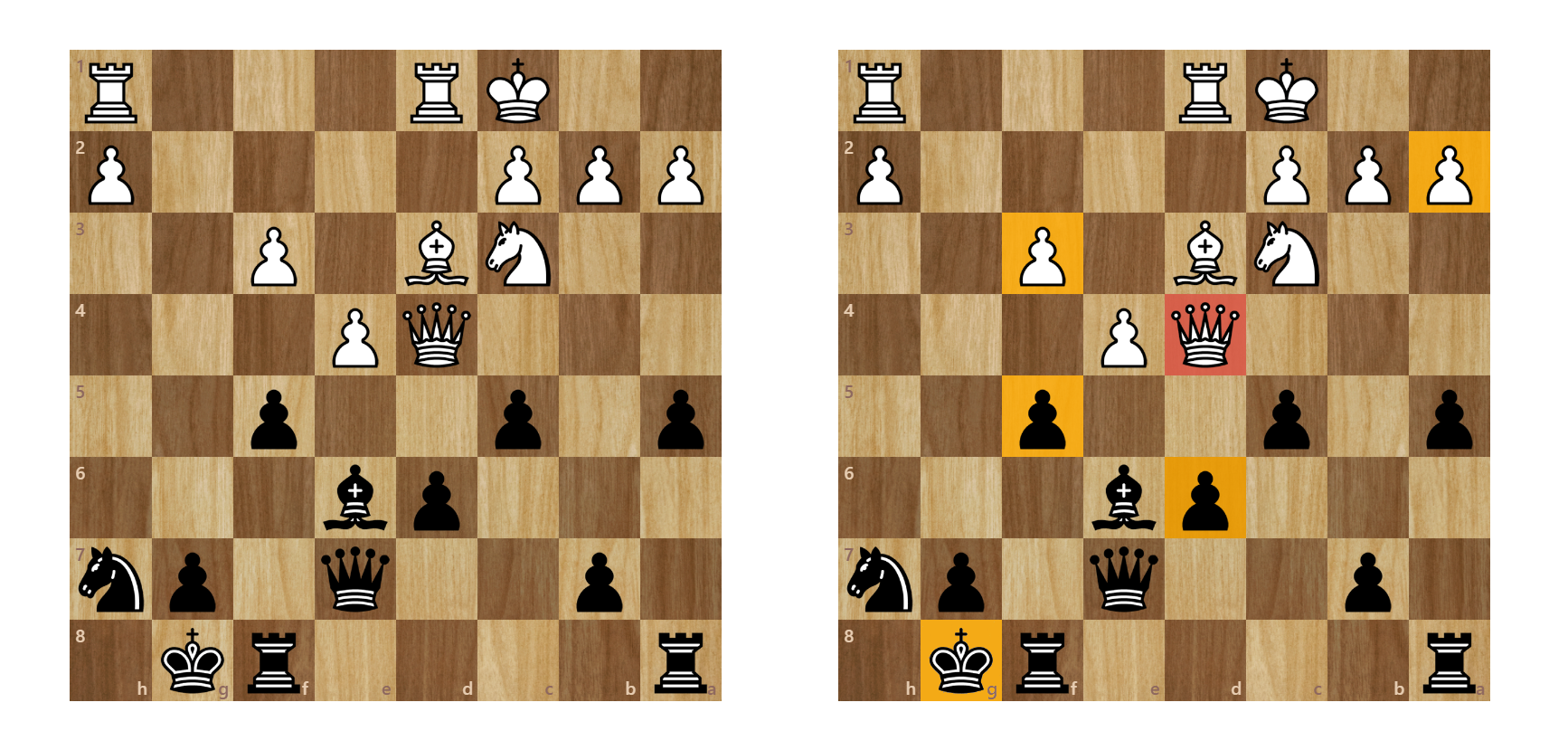
2) Your opponent made a move. What changed?
This contains two smaller steps.
Start with your rival’s ideas, so you don’t get too absorbed in your plan. Questions that can help: “Why did they play it?”, “What are they threatening?” or “What would they do next if they got another move?”. Really try to think like them here, and like you genuinely tried to find the best idea for them. Recall the vulnerable pieces you identified earlier. Can/did your opponent attack them with a forcing move (checks, captures, threats)?
Now you look for your side. What would you be threatening if your opponent wasn’t doing anything? Which of their pieces are exposed? Can you attack them with a forcing move?
Don’t calculate more than 3 moves ahead for now. You’ll likely just get lost, miss what’s happening on the board, or waste unnecessary time. Also, you mostly need to do it when there are forcing moves on the board, otherwise not really.
3) Comparison
Now that you have the information, which side has the stronger threat? Whose plan is more dangerous? Your opponent is about to checkmate you and you can only attack a weak Pony? You will need to defend first. You can fork their King and Queen, while they can only take your pawn next? We don’t have to care about that. :)
By “more dangerous”, I mean concrete moves that lead to checkmate or material loss. “Scary” shouldn’t impress you. If you don’t see an actual threat, assume it’s not there (great life advice too). There is a chance you will be wrong, but that’s fine. High-level players are not always right about their opponent’s ideas either. You need to learn to trust yourself, you’ll be more successful this way.
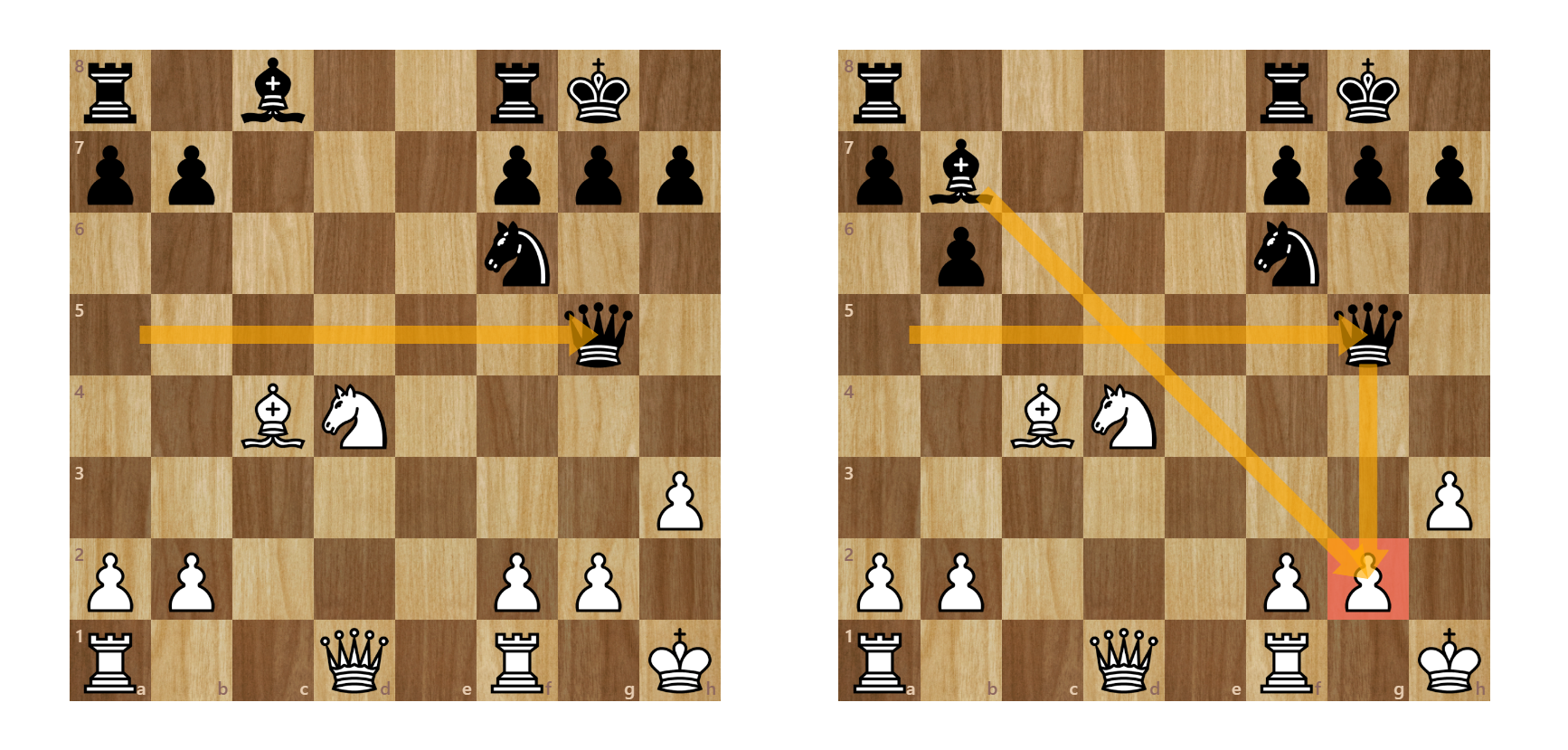
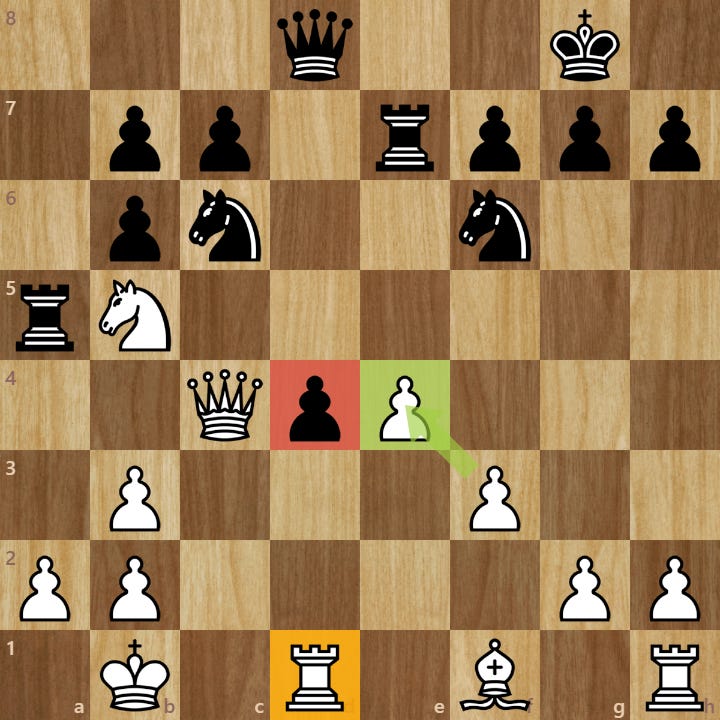
In both positions Black’s last move was Qa5-g5. In the first one, it might look spooky, but I don’t see how I will get checkmated, therefore I am not scared, I will not defend yet. In the second one, I am concerned, because I could get mated on g2. Now that’s a real threat, I need to act.
... Wait, but what if nothing is happening?
If neither side has anything serious, don’t worry. Improve your position: bring your pieces toward the center, put your worst piece to a better square, and so on. Be patient and wait for a mistake. You need to become comfortable with not always knowing what to do. Titled players don’t know the right ideas all the time either.
At these levels, your opponent will likely make a mistake or blunder sooner or later. If you consistently protect your pieces, notice your opponent’s threats, and take the opportunities they give you, you’ll improve much faster than someone trying to play like a grandmaster. Board vision first, strategy later. :)
4) Safety check
You found a move you want to play, awesome! Don’t play it yet. Visualize the piece in its new spot and look for changes that will follow. Does this move make anything red or yellow? Does your opponent have any forcing moves that can exploit these? If yes, reconsider the move. If no, but it created a new vulnerable piece, don’t just put it into a “no problem” box in your head. Add it to your mental list instead. You may not have to deal with it immediately, but you’ll want to remember it until the position changes.
Also, it’s better not to leave too many pieces yellow or red. If you are about to make a move that is technically safe, but it leaves something exposed, maybe reassess your choice. You don’t want to end up having to remember 5-6 vulnerable pieces for a long while, because the more there are, the more tactical possibilities can exist on the board. Slow down in such cases. One different sequence that you didn’t calculate, and these can easily become red and hang. Is it really necessary to keep so many things in mind? Complication is not always better.
Even if you find an answer after the first few questions, still go through the entire list. You need to see the whole picture before deciding what to play. Just like in life, you cannot make a good decision if you don’t understand what’s happening, or what’s at stake. :)
Also, notice how these steps are built on each other. If you immediately start looking for your move, you might completely miss a hanging piece. If you only focus on your opponent’s plan, you might miss that you could have taken their Rook for free. In this thinking order, you dramatically reduce the chance of blundering, while still giving yourself opportunities to attack.
You are right, this is tiring and takes a long time at first, but you’ll become much faster as your board vision improves. If remembering every red and yellow piece feels overwhelming, start smaller. Focus on the pieces and the King first, worry less about the pawns. Or if that’s still too much, pay attention only to the red ones. As your board vision improves, gradually include more.
One way to internalize this thinking process and speed up your improvement is to solve loads of easy tactical patterns such as forks, pins, skewers, etc. Play slow games, so you have time to implement this thinking method, and go through this list every move. Analyze both your own blunders and your opponent’s after the game. Dive into positions with many defenders and attackers, and practice seeing which side benefits materially from the exchange! Eventually you will realize it no longer takes conscious effort anymore.
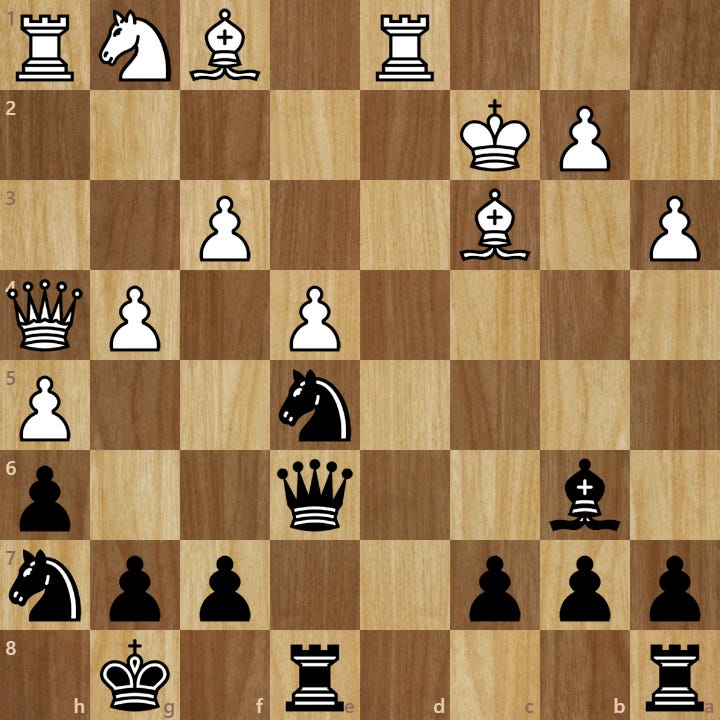
Let’s finish with a small exercise. Pretend this is one of your own rapid games. White’s last move was Qe1-h4. Before looking for a move, go through the previous thinking method, only then find a move.
Keep reading only after you’ve thought about it for at least 3 minutes.
By the way, in my next article, I will take a real game and apply this exact thinking process move by move. If you enjoyed this post and would like to see how it works in practice, don’t forget to subscribe! :)
Solution
Scan the board
Material is equal. At first glance, neither side has an immediate emergency (red tags). White’s yellow pieces: Ng1, f3 pawn, Kc2. Black only has one: the b7 pawn (hard to access, but still :)).
What changed?
White played Qe1-h4, they are not trying to do anything dangerous, so now I can focus on my own opportunities.
First I turn to the most valuable one: the White King. I don’t see a direct checkmate, so I am not yet convinced about the attack on his Majesty. Maybe I will later, but what about the other vulnerable pieces? Do I have any forcing moves related to them? Nxf3 and Bxg1. I pick one that seems the best to me: Bxg1, Rxg1, Nxf3 fork! Oh, that looks promising!
I still need to see the other forcing line. What if I start with Nxf3 instead? Nxf3, Nxf3, Qxe4+, Rd3! defends both the check and the Knight on f3. Less promising. It’s okay if you started with this line first, not even advanced players calculate the best line first sometimes (before calculating, you can’t know what’s right). This had to be analyzed too, since it’s forcing, and could have been better than the Bxg1 line.
As you can see, yellow doesn’t mean safe, but worth spotting or remembering. Sometimes nothing happens to them for a long time or at all (like the b7 pawn). Other times, one of them can suddenly become the center of a tactical sequence like the f3 pawn and g1 Knight. That’s exactly why we search for them, and keep track of them.
Comparison
White doesn’t have anything concrete, while we can win at least a piece. That’s an easy comparison then. :)
Safety check
You didn’t forget about this part, right? :) We want to play Bxg1. We took a Knight, so White really needs a strong forcing move as a reply. Do they have anything? No. Okay, so we are good to go.
Did you notice that I didn’t find this tactic because I magically “saw” it? (If I did, it would be thanks to the endless easy tactics that I have solved during my life... :)). I found it because I knew where to look. The thinking process narrowed my search.
I hope this thinking method makes your games feel a bit less overwhelming. If you try it in your next games, let me know in the comments how it went. I’d also love to hear if there are parts of the process you found difficult or questions you’d like me to cover in future articles.
If you’d like more personalized help with your chess, you can find information about my coaching HERE. :)
I agree this is an interesting and hopefully a valuable thing to use. I shall try to use it in my games, but a usual all these things you should do during a game, are hard to do, when the game gets intensive.
This is genuinely helpful 🙏🏽 The way you break down board vision and make it practical for improving players is really valuable. Keep pushing, coach — your work is appreciated! ♟️🔥